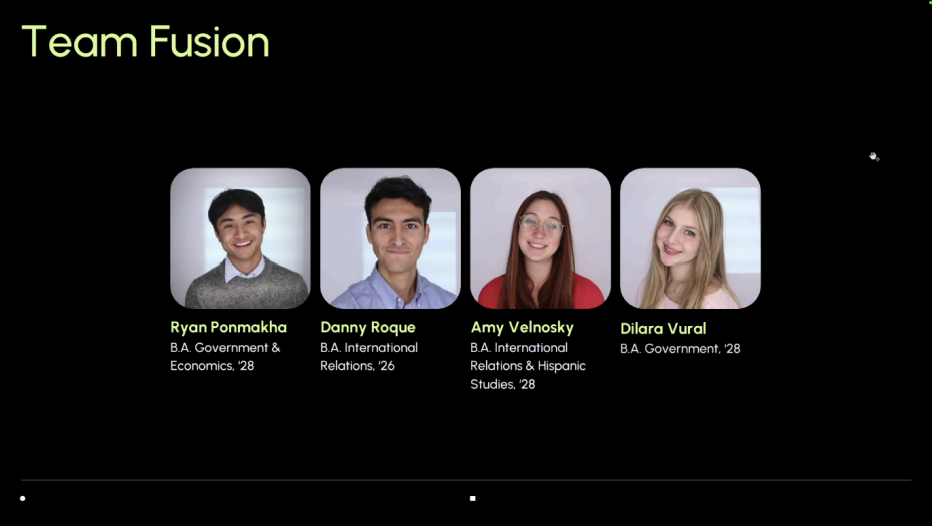
Team Fusion
Team Fusion
College of William & Mary
Accelerating mission insight from months to hours through unified, AI-driven data systems.
Danny Roque-Ballivian
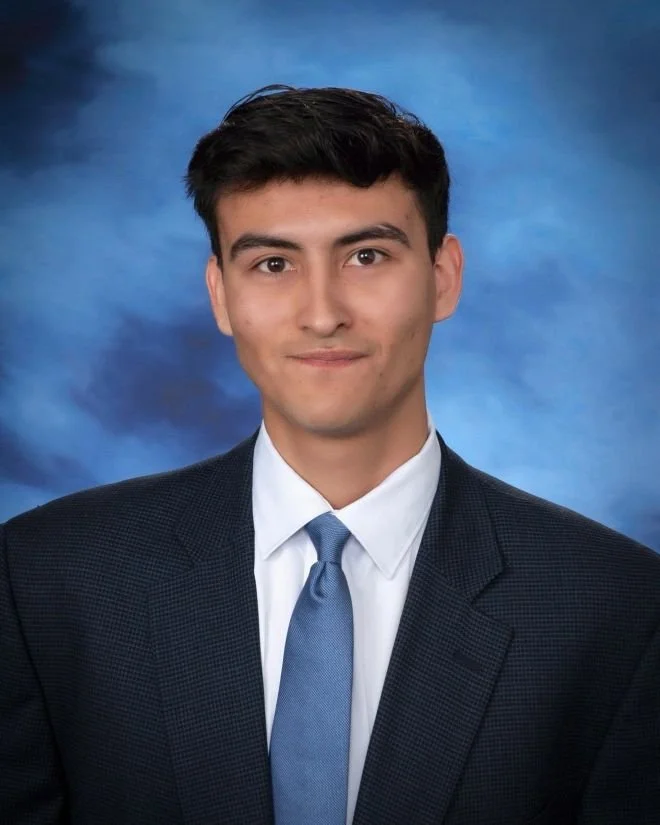
Danny Roque-Ballivian is an International Relations major with a concentration in Innovation and Entrepreneurship from the Class of 2026. He plans to pursue law school in the DMV area and a long-term career in prosecution, while exploring opportunities in the defense sector in the near term. As a member of Team Fusion, Danny is helping lead efforts to bring their H4D project to the next stage, with plans to apply to the H4D Summer Incubator Program and build a company from their research and prototype solutions for PACAF.
Overview
U.S. Air Force - Pacific Air Forces (PACAF)
Problem Sponsor
Original Problem Statement
Number of Interviews
Data Scientists responsible for analyzing and reporting mission outcomes and observations—like objectives achieved, enemy tactics, and resource challenges—cannot provide timely, actionable insights. Manual processing delays the delivery of critical information by up to two months, leaving insights on patterns, trends, and correlations outdated by the time they reach leadership, hindering their ability to adapt strategies, allocate resources, and make informed decisions in real time.
110
The Problem
When Danny Roque-Ballivian and his peers formed Team Fusion at William and Mary, they were met with this challenge from the U.S. Air Force – Pacific Air Forces (PACAF): mission outcome analysis was plagued by manual processing delays. Data scientists responsible for reporting objectives and enemy tactics were unable to provide timely insights, with critical information delivery lagging by up to two months.
The Discovery
Through an intensive discovery process involving 110 interviews, Danny and his team uncovered a deeper systemic issue within the C2IMERA system. C2IMERA is a U.S. Air Force tool designed to provide commanders with a real-time snapshot of base operations, including conditions, resources, and emergency situations, enabling more informed planning and decision-making.
However, the system – originally built for emergency reporting – had, over time, become overextended to support critical day-to-day logistics such as munitions and fuel tracking. This mission creep exposed fundamental limitations: the platform was clunky, not user-friendly, and unable to effectively integrate with legacy databases, forcing personnel to rely on manual workarounds and duplicative data entry. These inefficiencies not only slowed decision-making but also introduced opportunities for error in high-stakes operational environments.
Danny noted that the interview process provided an unfiltered view into the complexity of the defense ecosystem, revealing key friction points where critical information flows routinely break down. By engaging directly with end users across roles and units, the team was able to move beyond surface-level complaints and identify systemic gaps in interoperability, usability, and data reliability that ultimately shaped their problem framing.
The Innovation
Team Fusion’s innovation process was marked by several strategic pivots. They initially considered a policy memo to mandate system usage and even explored "Whisper" audio technology to speed up data entry. However, the breakthrough came when they realized the core pain point was the underlying data architecture. One wing user shared: "C2IMERA lacks basic export functionality... forcing them to manually rewrite information by hand." After hearing this, the team began to develop what would be their solution to the problem.
Their solution, Pacific AURORA (AI-driven Unified Readiness Operations & Resource Aggregator), proposes a new architecture that connects legacy databases to Command and Control (C2) systems via an Application Programming Interface (API). This is paired with an Artificial Intelligence overlay that allows commanders to quickly query critical information and receive base recommendations. The goal is to collapse the reporting cycle from two months to under 24 hours. Since the course ended, Danny and his team have continued developing this into a "middleware" solution to standardize data across Air Force silos.
Danny Roque-Ballivian’s H4D Experience
An International Relations major with a minor in Entrepreneurship and Innovation, Danny had no prior defense experience but was motivated by the chance to solve real-world problems for service members. He found the H4D lean startup methodology transformative, noting that it proved he could execute complex projects if he was willing to "investigate and listen to people to find underlying problems."
Despite the challenges of navigating the busy and ever-changing schedules of Department of War (DoW) personnel, and a significant time difference with their sponsor, Lieutenant Victor Rae, the team received lots of support from their professor, General Matthews. Danny emphasized that the program highlighted a profound "need for a new generation to secure America’s defense capabilities."
What’s Next
Danny relayed that the H4D experience has significantly altered his career trajectory. While his long-term goal remains becoming a prosecutor, the program opened doors to a round of interviews with defense contractors. He now plans to pursue a career in the defense sector, recognizing the high-impact opportunities available.